When Fiction Signs as Science
To insist on the boundary is not anti-science. It is the most pro-science position available, because the authority of physics rests entirely on its discipline about what can be tested.
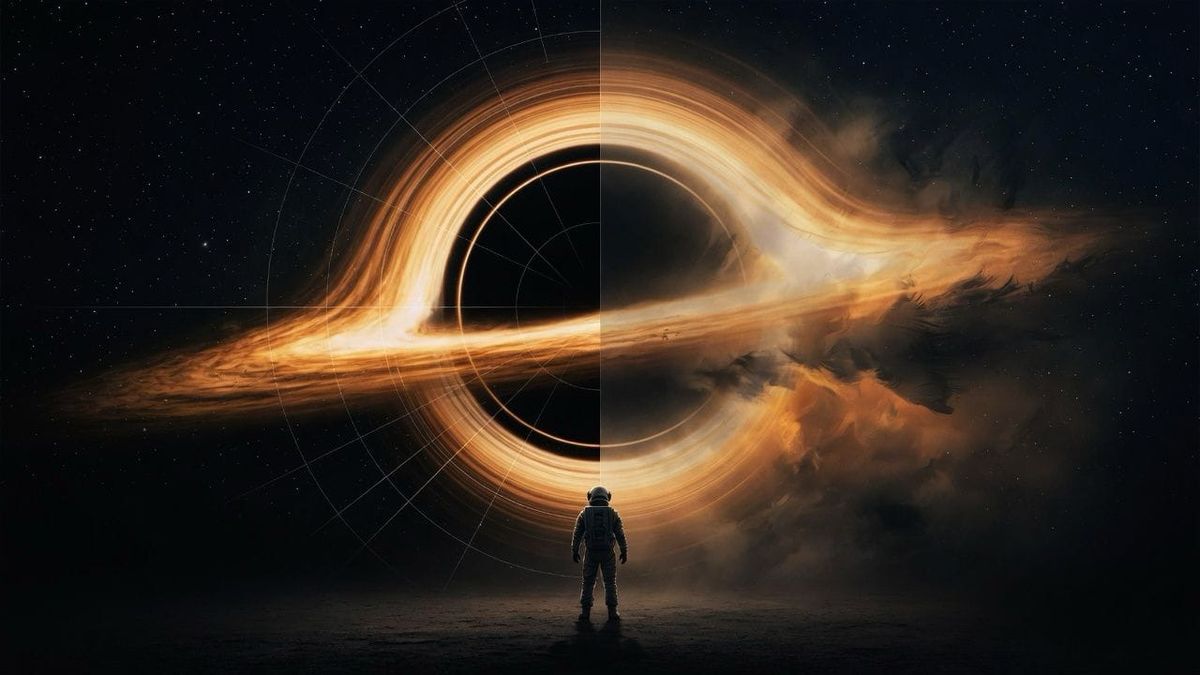
Interstellar, the Black Hole, and the Boundary Between the Measured and the Imagined
A Film Built on Real Physics
In 2014, Christopher Nolan released Interstellar, and it arrived with an unusual credential: its black hole, Gargantua, had been rendered with the help of one of the most distinguished physicists alive. Kip Thorne — who would go on to win the Nobel Prize in Physics in 2017 for his role in the detection of gravitational waves — served as the film's scientific consultant. He did not merely advise; he calculated. The visual depiction of the black hole was derived from the equations of general relativity, and the work was rigorous enough that it produced results worth reporting in the scientific literature. This deserves to be said plainly and with respect: Thorne is a physicist of the first rank, and what he achieved in that collaboration was genuine and admirable.
It is precisely because his credentials are real that Interstellar makes such a valuable case study. When a Nobel laureate lends his name to a depiction of the cosmos, the line between what physics can legitimately assert and what narrative merely requires becomes unusually instructive — because that line is drawn, crossed, and re-drawn within a single work, by someone fully qualified to know where it lies. The point of this essay is not to fault Thorne. It is to watch, in his own careful defence of the film, the exact moment where description of the observable gives way to invention about the unobservable — and to ask why we so rarely name that moment for what it is.
Where the Physics Holds
Much of the film's physics is defensible, and Thorne defends it with calculation rather than hand-waving. Consider the most criticised element: Miller's planet, orbiting so close to Gargantua that one hour on its surface corresponds to seven years on Earth. Critics objected that a planet that deep in a black hole's gravity well would be torn apart by tidal forces. Thorne's response was not rhetorical; it was arithmetical. He showed that if Gargantua spins fast enough — very near the maximal rate allowed by relativity — a stable, close orbit becomes possible in principle, and a planet there need not be ripped apart. He even computed the minimum mass the black hole would require for this to hold. Whatever one thinks of the result, this is how physics is supposed to work: a claim is made, a calculation is offered, and the claim stands or falls on the numbers.
This is the part of the film that earns the word science. It concerns regions that are, at least in principle, observable — the exterior of a black hole, the behaviour of orbits, the bending of light, the dilation of time. These are domains where general relativity has been tested and where its predictions can be checked against measurement. Within that domain, Thorne's work is not fiction dressed as science. It is science.
Where the Invention Begins
But there is a second register in the film, and it is here that the boundary is quietly crossed. Consider a problem the film never mentions but Thorne addresses in his companion book: the energy required for the spacecraft to accelerate to the relativistic speeds needed to reach Miller's planet, and then to decelerate again, is astronomical — far beyond anything the craft could carry. How is it done? Thorne's solution is revealing. The crew, he proposes, must have used a gravitational slingshot around a second, intermediate-mass black hole — one that happened to be in the vicinity of Gargantua at precisely the right moment. This object is never seen, never mentioned in the film, and is invoked, by Thorne's own account, more than once in the book to explain other implausible accelerations.
Notice the structure of this move, because it is the heart of the matter. When the observable physics does not close — when the energy budget fails — an unobserved entity, conveniently positioned, is introduced to make it close. The intermediate black hole is not demanded by any observation; it is demanded by the narrative's need for the numbers to work. It is a placeholder shaped exactly like the gap it fills. This is no longer description of what is; it is invention of what would have to be, so that the story may stand. And it is offered in the same voice, by the same authority, as the genuine calculation of the spinning black hole's tides. The two registers — the measured and the invented — wear the same coat.
The Object That Dissolves Itself
There is a deeper instance still, and it is the philosophical core of the matter. A black hole, in general relativity, is by definition a vacuum solution of Einstein's equations — a region where the energy-momentum tensor is zero. But for Miller's planet to survive its tidal environment, certain conditions on pressure and matter must hold near the hole. A physicist examining this noted the contradiction: if the pressures required become large enough, the energy-momentum tensor is no longer zero — and you no longer have the spacetime that contains a black hole at all. The very conditions the narrative needs, pressed to their conclusion, dissolve the object they were meant to describe.
This is the precise pattern worth naming. It is not that the mathematics is wrong; it is that the mathematics, applied to a scenario built for narrative, generates a situation in which the object under discussion ceases to be the object claimed. The fiction, taken seriously enough, undoes its own premise. And this happens silently — the film presents Gargantua as a black hole throughout, the audience receives it as one, and the contradiction is visible only to the one who does the calculation and is willing to follow it past the point of comfort.
The Selective Boundary
Here is the asymmetry that should give us pause. When Cooper falls into Gargantua and enters a tesseract — a navigable fifth-dimensional structure from which he manipulates gravity across time — everyone agrees this is fiction. It is labelled as such, defended as such, enjoyed as such. No one claims the tesseract is physics. But the interior of the black hole, the singularity, the very notion of a person crossing the horizon and persisting to report what lies within — these occupy an ambiguous zone, presented with enough scientific scaffolding that the audience cannot tell where the measured ends and the imagined begins. The boundary between science and fiction is not fixed in the film; it moves according to convenience. When a claim is testable, it is offered as science. When it is not, it is offered as science anyway — until challenged, at which point it retreats to fiction.
This selective boundary is the real subject of this essay, and it extends far beyond one film. A person entering a black hole is, in the strictest sense, unobservable: no signal returns, no measurement is possible, no observer crosses the horizon and comes back to tell us. To describe what happens “inside” is not to do physics, because physics, in its operational meaning, concerns what can be measured, compared, and — in principle — checked. The interior of the singularity is, by construction, the place from which no check can ever come. To narrate it is a legitimate act of imagination. To narrate it in the voice of established science, and to retreat to “it was only fiction” only when pressed, is to blur the one distinction that gives science its authority.
Placing the Achievement Where It Belongs
None of this diminishes Kip Thorne. His rendering of the black hole's exterior, his calculations of tidal survival, his treatment of time dilation — these are real contributions, and his Nobel Prize rests on work of the highest order. The argument here is narrower and, I hope, fairer: that even in the hands of a master, when the description reaches past the horizon of the observable, it necessarily becomes invention — and that we owe ourselves the honesty to mark the transition. Thorne's genius is not in question. What is in question is a cultural habit, in which the prestige earned in the domain of the measurable is extended, without announcement, into the domain of the unmeasurable.
The lesson is not that we should stop imagining the cosmos. Imagination is how science begins. The lesson is that we should keep the boundary honest — to say, of the spinning black hole's tides, “this is calculated, this is physics,” and to say, of the journey through the singularity and the convenient unseen black hole, “this is imagined, this is story.” Both have their place. What corrodes understanding is the migration of the second into the costume of the first.
The Larger Point
Interstellar is only the clearest illustration of a habit that runs through how we speak of the cosmos. We treat the universe, at times, as a place we may eventually visit and manipulate — wormholes as routes, black holes as gateways, the deep cosmos as a frontier awaiting our footprints. Much of this is sold, explicitly or by implication, as the natural extension of science. But a great deal of it concerns precisely what lies beyond the horizon of any possible observation — and there, the rigorous equation and the hopeful fantasy become difficult to tell apart, because neither can be checked.
To insist on the boundary is not anti-science. It is the most pro-science position available, because the authority of physics rests entirely on its discipline about what can be tested. The moment we allow that authority to underwrite the untestable, we have not expanded science; we have diluted it. The cosmos deserves our imagination. It also deserves our honesty about which is which. And the surest sign that we have lost that honesty is the day we can no longer say, of a beautiful claim about the unreachable, whether it is something we measured or something we wished.
Physics is the discipline of what can be checked. Beyond the horizon of the check, there is no physics — only the imagination, which is honourable, provided it does not borrow a coat that is not its own.