What if you are not the author of your existence?
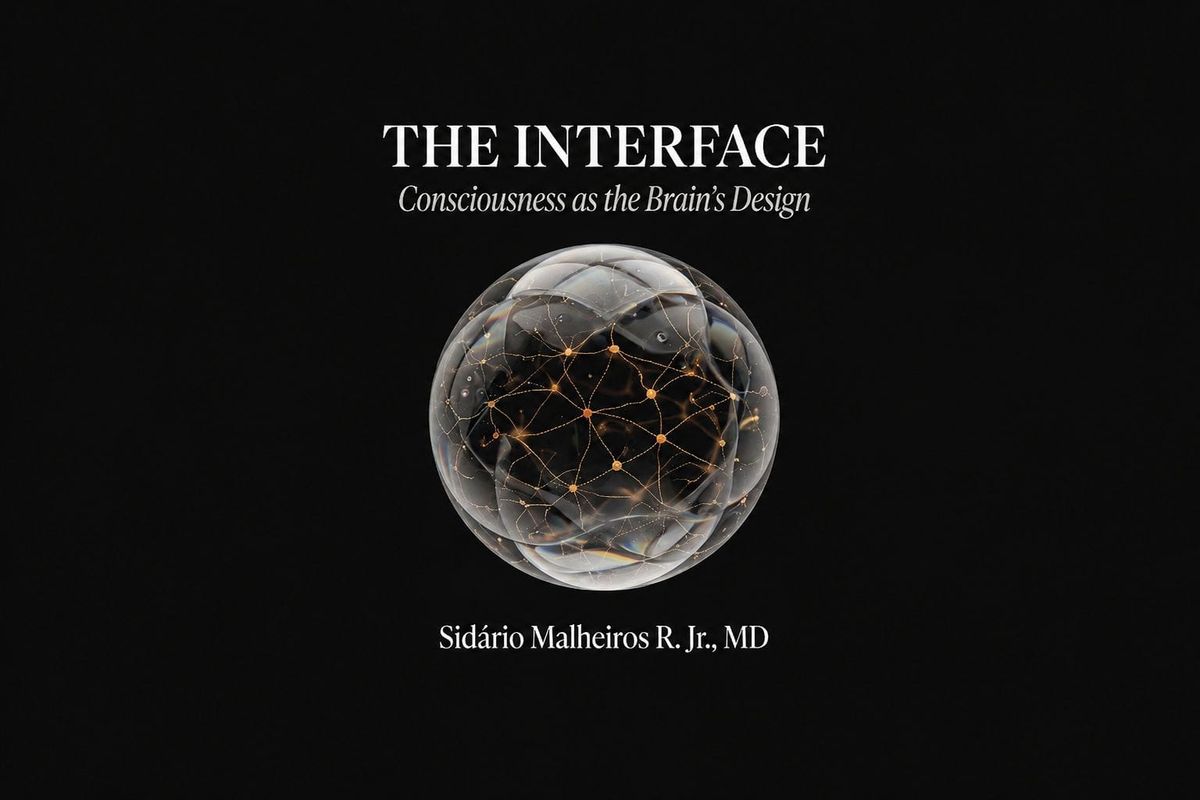
The Interface — Consciousness as the Brain's Design
The brain did not give you existence.
It gave you the experience of existing — so that you would never interfere with what it was doing.
The Question Nobody Asked
For four hundred years, philosophers have asked the same question: why does the brain produce consciousness? Why does the firing of neurons give rise to the warmth of sunlight on your skin, the ache of a memory, the specific irreplaceable quality of the person you love?
David Chalmers called this the hard problem of consciousness. And it is hard — brutally hard — if you accept the premise. If you start from the assumption that consciousness is something the brain produces while doing something else, you face an explanatory gap that three decades of neuroscience and philosophy have failed to close.
But what if the premise is wrong?
What if consciousness is not what the brain accidentally produces — but what the brain deliberately deploys? Not a byproduct. An instrument.
"The experience is not what leaks out of the brain. It is what the brain uses."
The Engineering Problem
Here is what the brain actually needs to do: continuously remodel its own architecture in response to a world that never stops changing. Every experience rewires it. Every loss, every discovery, every moment of attention modifies its connectivity. This is not a metaphor — it is the physical process of synaptic plasticity, running constantly, beneath the threshold of awareness.
But here is the problem. A system cannot remodel itself while the organism consciously monitors the remodelling. An organism aware of its own neural rewiring — aware that its preferences, its emotions, its sense of self are being modified in real time — would resist the modification. Would try to intervene. Would short-circuit the very process that makes it capable of surviving and adapting.
The brain needed a solution. And it found one.
It built you.
It constructed an agent — the self — and gave that agent a world so rich, so beautiful, so compelling to inhabit that the agent would engage with it fully, without ever asking what is happening underneath. You pursue meaning. You form attachments. You feel wonder and grief and desire. While you do all of this, the brain is using every experience you have to build itself into what it needs to become. You are the interface through which the brain encounters the world. And the interface was designed to be believed.
What the World Is Actually Like
The world has no colour. No sound. No smell. These are not properties of physical reality — they are properties of your brain's response to it. Light at 700 nanometers has no redness. Pressure waves at 440 Hz have no musical quality. Certain molecular configurations have no fragrance.
The brain converts all of this into an experience so vivid, so apparently self-evident, that it feels like direct contact with reality. It is not. It is a translation — a rendering — calibrated not to be accurate, but to be motivating. The colour red does not exist to inform you about wavelengths. It exists to make certain distinctions immediate and consequential enough that you act on them without deliberation.
The interface is not a window onto the world. It is a motivational architecture built from the world's inputs — designed to make you engage with maximum intensity, generating exactly the data the brain needs to develop itself.
This is why the interface is seamless. An interface with visible seams — one that invited you to examine its own construction — would be an interface that disrupts the very engagement it exists to sustain. The brain generates a world that presents itself as discovered, not constructed. As given, not produced. Because a world you believe in produces a self that acts in it fully. And a self that acts fully generates everything the brain requires.
What You Are
This does not mean you do not exist. It means your existence has a specific ontological status that no philosophy has previously described with precision.
You are what I call the Projected Self: the functional character the brain generates to inhabit its interface. Real — genuinely, completely real. Your love is truly felt. Your grief is truly suffered. Your identity is truly yours. But you are not ontologically independent of the system that generates you. You are, in the most precise sense, the brain's most sophisticated product — and its most essential instrument.
01. Your identity is not what you believe about yourself. It is the characteristic way your brain processes experience — your interpretive signature. Unique, irreducible, yours alone. No other brain has ever produced exactly this self.
02. Your emotions are the brain's motivational vocabulary — each neurotransmitter a specific instruction to the interface. Dopamine does not mean pleasure. It means pursue this. Oxytocin does not mean love. It means this one is necessary. The feeling is real. The function is precise.
03. Your sense of meaning — the experience that certain things, certain people, certain pursuits genuinely matter — is the brain's highest-register engagement tool. Organisms that find life meaningful explore it more deeply, form richer connections, generate more adaptive data. Meaning works. So the brain generates it.
The Clinical Proof
This is not speculation. The evidence is in the clinic — in what happens when the interface begins to fail.
In Alzheimer's disease, the self does not disappear uniformly. It dissolves in a specific sequence — the most expensive elements of the interface failing first, the deepest and most consolidated traces surviving longest. The self has an energy cost. Maintaining the narrative continuity of who you are — the sense of being a coherent someone persisting through time — requires continuous metabolic expenditure. When the brain can no longer afford it, the self begins to fragment. Not the neurons. The interface.
Consider the patient in an advanced state of dementia. He cannot recognise his family. Cannot orient to time or place. Cannot produce coherent speech. By every clinical measure, the self is gone.
Then someone plays a song. A song from forty years ago, from a period of his life his family tells us mattered deeply to him. And he begins to cry. And then — devastatingly, unmistakably — he begins to sing.
The memory was not lost. The trace was there. What had collapsed was the energy to reach it by ordinary routes — the high-cost executive pathways that normally enable voluntary recall. The music provided a shortcut. A lower-cost access path to a trace so deeply consolidated that the failing brain could still afford it.
"The brain in advanced neurodegeneration is not dark. It is an archipelago — islands of preserved function, separated by collapsed thermodynamic bridges."
This is the interface in its final state: not extinguished, but reduced. The last affordable traces of who someone was — accessible only through the right key, at the right cost, before the system finally cannot sustain even those.
What This Changes
If consciousness is the brain's instrument rather than its accidental output, then the hard problem of consciousness — the great unsolved mystery of philosophy — was never a mystery about why the physical produces the experiential. It was a mystery about what the experiential is for. And once you ask that question, the answer is not mysterious at all.
The experience is for engagement. The self is for agency. The interface is for generating the inputs the brain requires to build itself. The seamlessness is a design feature. The belief is the mechanism. You were never meant to see behind it — because seeing behind it would break it.
Understanding this does not diminish you. It does not make your love less real, your grief less significant, your identity less yours. It reveals, for the first time, what you actually are: the brain's most ambitious project — an agent so fully inhabited that it never suspects it is an agent, a self so completely believed that it generates everything its brain requires to become what it needs to be.
You are not the author of your existence. You are its protagonist. The brain writes the story. You live it — completely, genuinely, irreversibly.
And that, it turns out, is enough.
— — —
The Interface — ZCO MEPH Trilogy · Vol. III
The complete argument. Ten chapters. The third volume of the ZCO MEPH Trilogy — completing a unified theory of subjective existence that spans thermodynamic neuroscience, phenomenological philosophy, and the clinical evidence of what the brain loses when it can no longer sustain the self it projected.