The Hand That Cannot Tell the Time
The hand measures time and does not know the hour, because it is inside the measuring device. To know, one must step out — and perhaps that is the only place from which a universe inside a bottle can, at last, be seen.
On Exteriority as the Condition of Seeing
“If no one asks me, I know; if I wish to explain it to him who asks, I do not know.” — Augustine, on time
The Clock's Hand
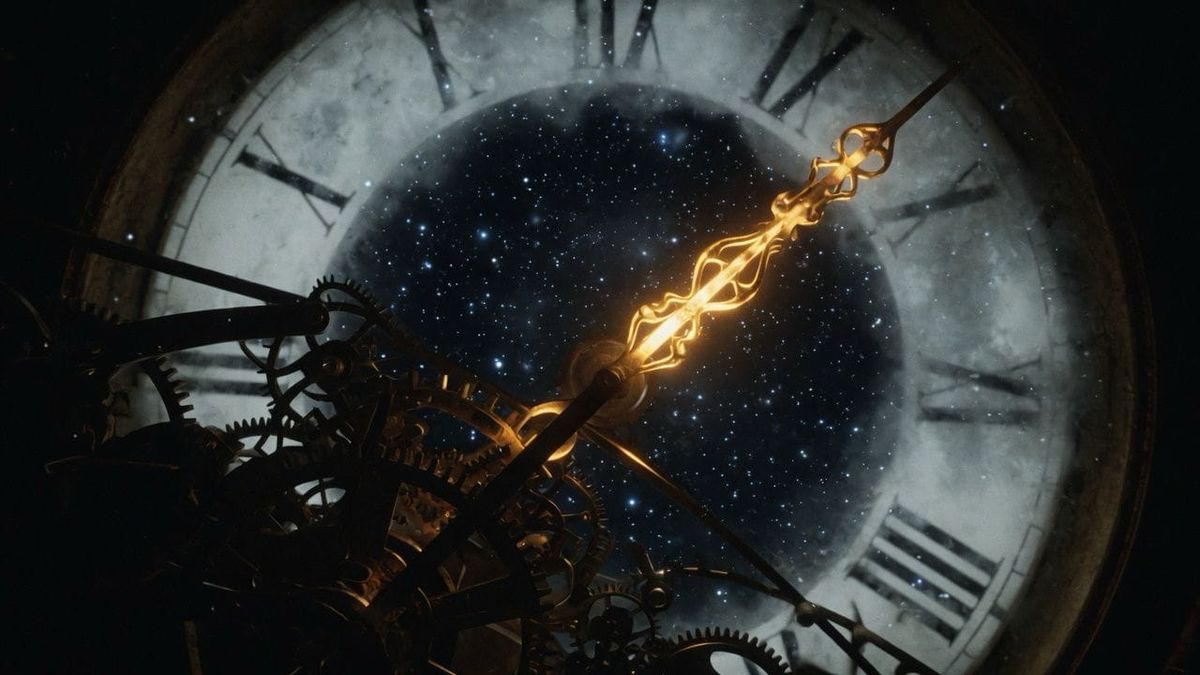
Consider the hand of a clock. It measures time with precision; that is its sole function, and it performs it without fail. And yet the hand does not know what time it is. Not for want of a finer mechanism, but for a deeper and irremediable reason: it is inside the measuring device. It is part of the very apparatus that produces the measure, and so it cannot read it. To know the time, one needs someone outside the clock, who looks at the hand against the face. Reading requires a vantage point that the hand, by its very construction, will never have.
This small image contains, I submit, one of the most underrated principles of knowledge. Augustine came near it sixteen centuries ago, confessing that he knew what time was until the moment he was asked to say. He treated it as a paradox of the soul; but what he was touching, without the word we would use today, was an epistemological problem. To know presupposes exteriority to the known. The hand cannot read itself; the soul cannot grasp time from within time; and — this is the extension I propose — no system of thought sees itself entirely from within itself.
The Bottle
Imagine that someone wishes to understand the universe, and that, to do so, they place the universe inside a bottle — the bottle being the set of assumptions, equations, and habits of thought inherited from their age. From within, everything seems to fit. The universe, seen through the glass, conforms to the shape of the glass; and since one has never seen the universe any other way, one concludes that the universe has that shape. The bottle becomes invisible, because everything is seen through it. No one inside asks about the bottle, because the bottle does not appear — it is the condition of all appearing.
It is only from outside that one notices there was a bottle at all. Whoever steps out — or whoever was never inside — looks and says: what was taken for the universe was the universe shaped by the glass. The form that seemed natural reveals itself as an imposition of the container. Not that the one inside was foolish; on the contrary, they may have been the most rigorous of observers. But rigor exercised entirely inside the bottle perfects the view of the contents without ever reaching the glass. The better one sees within, the less one suspects the container.
The Fixity of Those Within
There is a reason the assumptions of a system are invisible to those who think by means of them. Whoever inhabits a paradigm does not think about its assumptions; they think through them. The assumptions function like air — the condition of all breathing, never its object. The specialist inherits these foundations at the start of their training, before they have the maturity to question them, and thereafter builds all their competence upon them. To question them later is not merely difficult; it is almost counter-intuitive, for it would require dismantling the very ground on which one's competence was raised.
From this follows a consequence that is not about truth but about probability — and I want to be precise, because the difference matters. I do not claim that the one outside sees the truth. I claim something more modest and more defensible: it is more probable to see a problem from outside it than from within. It is more probable that a stuck equation will yield by changing the equation than by insisting on the same one. The one who comes from outside brings no guarantee of being right; they bring the statistically greater chance of seeing the assumption the insider cannot see — because they see it as a choice, and not as nature.
The history of knowledge confirms the tendency. Decisive advances have come, with notable frequency, from those who crossed the boundary of one discipline carrying the tools of another — from the stranger to the field, who had not internalised its prohibitions. Not because the stranger was more intelligent, but because they were not bound by the habit that made certain questions unthinkable for the natives. The outsider's advantage is not possession of the answer. It is the freedom to ask the question that, inside, no one asks.
To See Is to Step Out
Gather the three figures, for at bottom they are one. The hand that cannot tell the time because it is inside the measuring device. The bottle that cannot be seen because everything is seen through it. The paradigm that cannot be examined because it is the medium of examination. In each case, the same structure: the instrument that produces the seeing cannot become the object of its own seeing without a point of support outside itself. Archimedes asked for a place to stand outside the world in order to move the world. Knowledge asks for a point of observation outside the system in order to see it anew.
And here Augustine's intuition shows its depth. He said that God knows time because He sees it from outside — from an eternity not immersed in the flux it measures. One need not accept the theology to harvest the epistemology it carries: to know a thing fully requires a place that is not inside it. Time could only be known from an exteriority to time; the universe, perhaps, can only be rethought from an exteriority to the system that thinks it. Exteriority is not a luxury of knowledge. It is its condition.
The Necessary Stranger
From this I draw a defence — not of myself, but of a position. When someone outside a field dares to rethink its foundations, the habitual reaction is disdain: what can someone who does not live inside physics know about the cosmos? But the question, turned inside out, reveals its naivety. Perhaps it is precisely because they do not live inside the bottle that the stranger can see the glass. I do not say they will be right — most of the time they will not, and they must submit what they see to the test of those who know the contents from within. I say only that their question carries a value that internal competence cannot generate on its own, because internal competence is precisely what renders the glass invisible.
This is the honest division of labour between the one within and the one without. To the one within belongs rigor over the contents: the calculations, the measurements, the control of what can be checked. To the one without belongs suspicion of the container: the question that internal habit has rendered unthinkable. Neither suffices alone. The insider without the outsider perfects, indefinitely, the view inside the bottle. The outsider without the insider sees the glass but does not know the contents. Knowledge advances when the question from outside meets the rigor from within — and not when either pretends to dispense with the other.
Why We Look from Within
All of this casts a light on a habit that runs through the way we speak of the cosmos. When an entire culture describes the universe — narrates the interior of a black hole, promises habitable worlds, projects upon the cosmos a time that exists only inside a brain — it does so, almost always, from inside the bottle: with inherited equations, unexamined assumptions, the confidence that the container is the world. The errors that result are not, in general, failures of rigor. They are what the universe looks like when seen from inside a single container, by those who never suspected there was glass.
The way out, then, is not to measure better inside the bottle. It is to have the courage to step out of it — or to listen to those who are outside. Not to abandon rigor, but to submit it to a question that rigor, alone and from within, never frames: what if the shape we take for the universe is the shape of the glass? Perhaps science need not be corrected. Perhaps it need only be seen from another angle — and new models, new equations, will be born only of that angle, which by definition is not reached from within. The hand will go on not knowing the hour, however perfect it becomes. The hour is known only to the one who looks at the clock from outside.
The hand measures time and does not know the hour, because it is inside the measuring device. To know, one must step out — and perhaps that is the only place from which a universe inside a bottle can, at last, be seen.