The Brain Is Not a Hard Drive
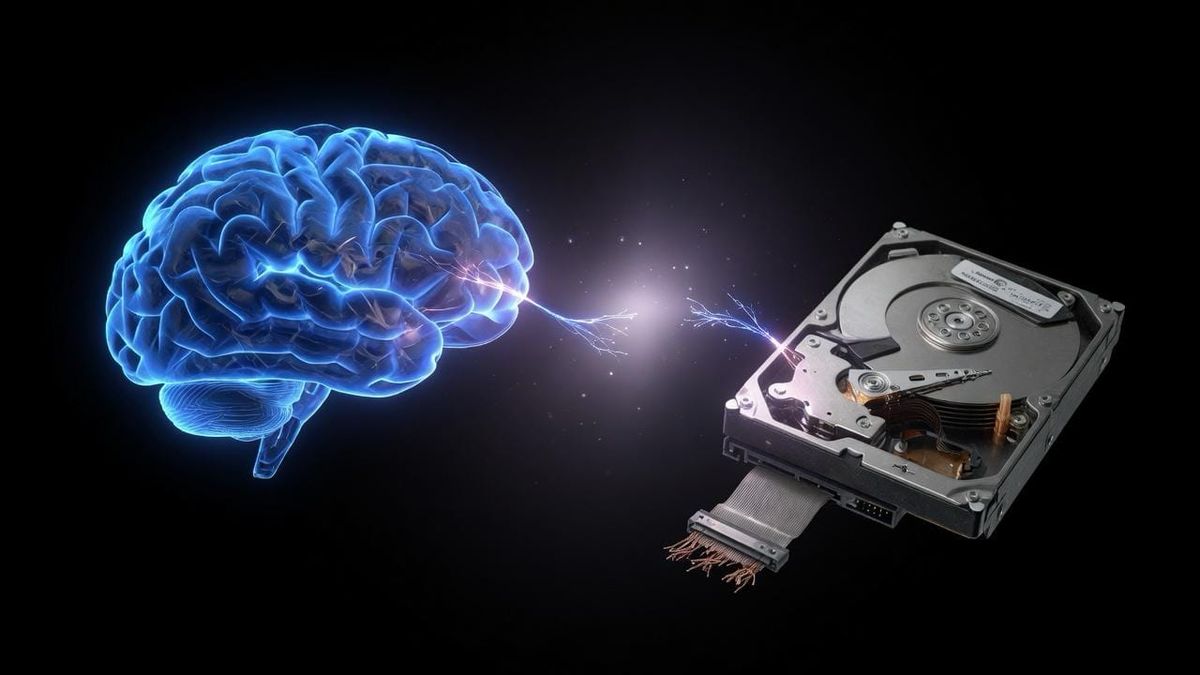
Why consciousness cannot be downloaded — and what that means for the future of neural interfaces
I measured it.
Not consciousness. Movement. And the difference between those two things is the entire argument.
What electrodes actually measure
During my research at the Laboratory of Electroencephalography and Electrostimulation at UERJ, I spent months mapping motor cortex with transcranial magnetic stimulation. The protocol was precise: ninety magnetic pulses over the identified hotspot of the primary motor cortex, at staggered intervals to prevent signal contamination, while electrodes on the first dorsal interosseous muscle recorded the response.
The response — the Motor Evoked Potential — is measurable in millivolts. It has latency in milliseconds. It has a cortical address locatable to five millimetres with neuronavigation. When the pulse hit that address, the finger moved. Reliably. Quantifiably. Every time.
This is what brain-computer interface implants do — more invasively, with higher resolution, but the same principle. A signal at a localised cortical address produces a quantifiable motor output. It works because the motor system is architecturally simple: cortex to spinal cord to muscle. Almost a peripheral system. It has an address. It has an amplitude.
One of the pioneers who built the scientific foundations of this field — the Brazilian neuroscientist Miguel Nicolelis, professor at Duke University — has long warned that this success should not be extrapolated. In his view, cognition cannot be reduced to the activity of discrete neural populations. The brain operates through large-scale distributed ensembles, and reading a handful of motor neurons with implanted electrodes captures a marginal fraction of what makes the brain the brain. More electrodes, Nicolelis has argued, will not solve this — because the problem is not resolution. It is category.
I agree. And I want to show exactly why — from three arguments that go further than the neurobiological critique alone.
Argument One — The memory that has no address
Consider the smell of food your mother made. The specific fragrance that, encountered unexpectedly after twenty years, collapses the distance in a single moment — returning you completely to a kitchen, a sound, a quality of light, a feeling of safety you had forgotten you carried.
Where is that memory in the brain? It has no address. It is a simultaneous re-engagement of olfactory cortex, hippocampus, amygdala, prefrontal cortex, and every associative network connecting them — all at once, distributed, requiring the coordinated activity of millions of neurons above a critical energetic threshold. There is no millivolt value for it. There is no neuronavigation hotspot. No electrode locates it, reads it, or copies it.
Because it is not a signal. It is a thermodynamic event — a reconstruction that only exists while the energetic conditions that sustain it are met.
I call this Constitutive Depth: the degree of simultaneous multimodal neural integration achieved during a single encoding event. A high-depth experience engages multiple sensory cortices, hippocampus, amygdala, and prefrontal cortex simultaneously. The result is a connectivity architecture so redundant and so distributed that dismantling it would cost more energy than sustaining it indefinitely. It persists not because it is reinforced — but because erasing it would be more expensive than carrying it.
Standard memory theory says connections decay without reinforcement. This is true for most memories. But it fails to explain the memories that were encoded once and remain unchanged across decades — the first love, the face of a childhood pet, the smell that returns a place that no longer exists. These traces survived not through rehearsal but through depth. They rewrote the brain that had them.
Aristotle described this phenomenon without the vocabulary to formalise it. In the Nicomachean Ethics, he described eudaimonia not as sustained pleasure but as the moment that has value in itself — the instant you do not want to end, that transcends the time in which it occurs and propagates through an entire life. He was describing a high-Constitutive-Depth event. The moment at which consciousness becomes not merely the brain's product, but its architect.
"The brain does not store. It connects. And the connections that matter most cannot be found at any address."
Argument Two — The patient who sang
A patient with advanced Alzheimer's disease. Near-vegetative state. He cannot recognise his family. Cannot orient to time or place. Cannot produce coherent speech. By every clinical measure, the person appears to be gone.
Someone plays a song from forty years ago — identified by his family as deeply significant to a specific period of his life.
He begins to cry. Then he begins to sing.
The memory was not lost. The energy to reach it by ordinary routes was gone. The high-cost pathways of voluntary recall had fallen below their critical threshold. The music provided a lower-cost route — through emotional memory circuits whose Constitutive Depth at original encoding made them structurally irreversible. The island was alive. The bridges had collapsed.
No neural interface has ever restored those bridges. I worked with HD-tDCS in the same laboratory — a technique that modulates cortical excitability and can temporarily improve cognitive performance. When stimulation ends, the brain returns to its baseline. The stimulation modulates a signal. It does not repair the substrate.
The substrate is the gradient — the continuous thermodynamic process maintained by billions of cells, the neurovascular unit, the pericyte, the mitochondria of every synaptic terminal. Consciousness is not the pattern. It is the process that keeps the pattern alive. Remove the gradient and the pattern remains — silent, static, and without experience. A dead brain retains its synaptic architecture for hours. It produces no consciousness because the gradient is gone.
You cannot download a gradient. You can read the signals it produces. But the gradient itself is not a signal. It is a state maintained by biology that no digital substrate replicates.
Argument Three — The brain works hidden
Here is the argument that settles the question entirely.
You do not remember the first three years of your life. You do not remember 99% of the days you have lived. You do not remember the vast majority of sensory inputs, emotional responses, and social pressures that shaped the neural architecture you currently possess. These experiences left no accessible episodic trace. They produced no memories you can retrieve.
And yet they constitute, in the most fundamental sense, who you are.
I call this Subthreshold Constitution: the cumulative modification of the neural substrate by experiences that never reach the threshold of conscious memory formation. The brain processes these experiences, drives synaptic change in response to them, shapes connectivity patterns and neurochemical sensitivities through them — entirely outside the reach of conscious awareness. The brain works hidden from the self it projects. The individual is, in large part, the result of what the brain did while the self was not looking.
The brain also forgets deliberately. Synaptic pruning eliminates high-cost connections that no longer justify their energetic burden. Forgetting is not failure — it is function. It is the brain reducing its maintenance cost by eliminating what is no longer worth carrying. But the pattern produced by selective elimination carries the structural signature of what was removed. The absence is part of the architecture. You are constituted partly by what your brain decided not to keep.
To download a consciousness completely, one would need to reconstruct not only what the brain currently contains, but what it has eliminated, why it eliminated it, what remained in its place, and the full thermodynamic history of every modification from birth to the present. One would need to download not a state, but an irreversible history spanning an entire lifetime of biological time.
Episodic memory is not the individual. The individual is the result of all experiences that were and were not registered in memory — that modified the substrate regardless of whether they left an accessible trace. You are not the sum of what you remember. You are the sum of everything your brain processed, modified itself in response to, and either retained or deliberately forgot, across an entire lifetime.
What neural interfaces can and cannot do
Brain-computer interface technology has achieved something genuinely remarkable: reading motor cortical signals with sufficient fidelity to restore voluntary movement to paralysed individuals. This works precisely because the motor system has an address, a quantifiable output, and an architecturally simple pathway from cortex to muscle. The achievement is real. The clinical value is undeniable.
The question is not whether electrode-based technology can read signals. It demonstrably can. The question is whether signals are what consciousness is. And the answer — from the evidence of Constitutive Depth, from the thermodynamics of the gradient, from the reality of Subthreshold Constitution — is no.
Signals can be read. Gradients cannot be copied. Patterns can be mapped. Histories cannot be reconstructed from their outcomes. And the person — the actual individual, constituted by decades of processing that consciousness never witnessed — is not accessible to any electrode, at any resolution, of any kind.
Nicolelis was right that the problem is not resolution. But it is even deeper than the neurobiological argument reaches. The problem is that what makes a person a person is not located anywhere that an electrode can find.
"It is not a file. It is not a pattern. It is not a state. It is the person — and the person is a history that no hard drive can hold."
— — —
Constitutive Depth · Constitutive Retroaction · Subthreshold Constitution
Paper: Why Consciousness Cannot Be Downloaded — A Thermodynamic Critique of Neural Interface Theory
Framework: Brain Thermodynamics · The Interface · Zona de Contato Ontológico